Simplifying the Form-Sending Process in Acrobat's E-Signature Space
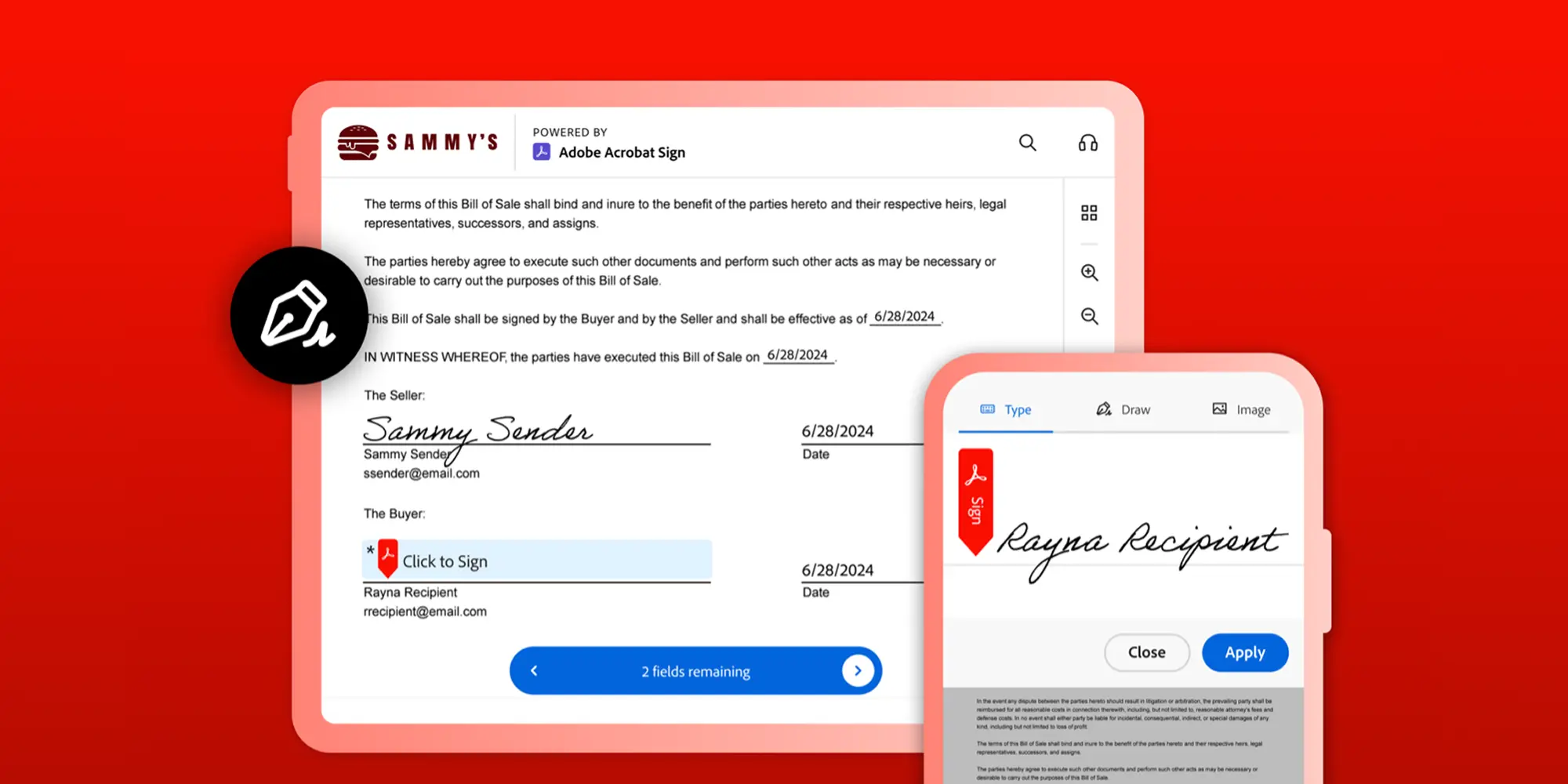
Led mixed-method research (12 interviews, 100+ surveys) uncovering enterprise SaaS workflow pain points, driving insight-based design recommendations that boosted B2B value realization by 12% and culminated in shipping a new cross-platform e-signature experience (Q4 2024).
Role
UX Researcher
Role
UX Researcher
Role
UX Researcher
Duration
May 2024 - Aug. 2024
Duration
May 2024 - Aug. 2024
Duration
May 2024 - Aug. 2024
Team
PM & Designer (Stakeholders)
Team
PM & Designer (Stakeholders)
Team
PM & Designer (Stakeholders)
Tools
UserInterviews, Miro, Slack, AirTable, Qualtrics,Teams
Tools
UserInterviews, Miro, Slack, AirTable, Qualtrics,Teams
Tools
UserInterviews, Miro, Slack, AirTable, Qualtrics,Teams
For my full experience…
Due to the sensitive nature of this project, detailed insights about participants and certain project specifics cannot be disclosed. However, if you’re interested in learning more about what I worked on in more detail, please feel free to reach out!
For my full experience…
Due to the sensitive nature of this project, detailed insights about participants and certain project specifics cannot be disclosed. However, if you’re interested in learning more about what I worked on in more detail, please feel free to reach out!
For my full experience…
Due to the sensitive nature of this project, detailed insights about participants and certain project specifics cannot be disclosed. However, if you’re interested in learning more about what I worked on in more detail, please feel free to reach out!
My research was used to ship a new feature!
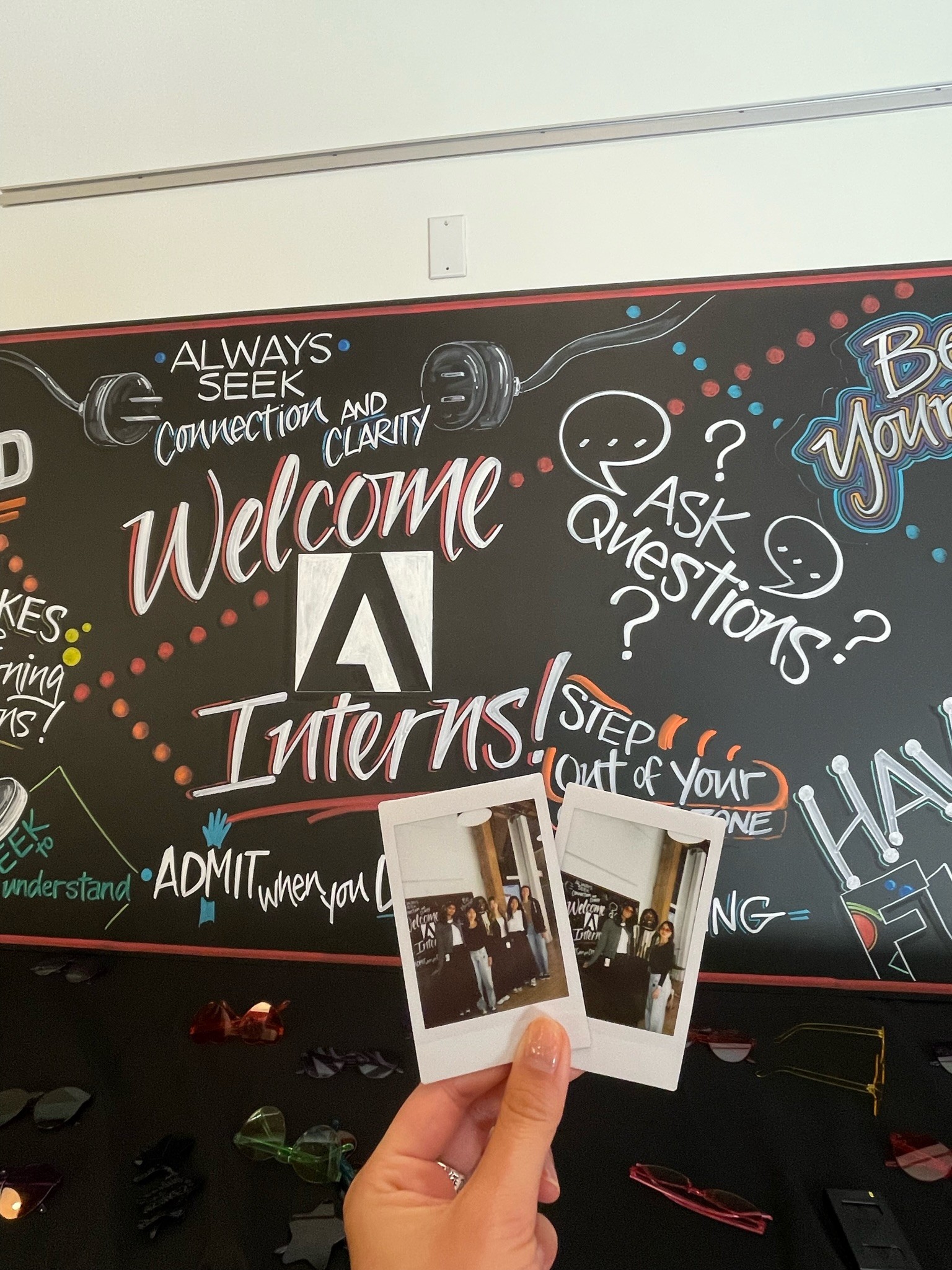
Document Cloud's First Experience Research Intern!
For 12 weeks, I had the greatest privilege to work as the first experience research intern on the Adobe Document Cloud team with an amazing and talented community of people.


Research Overview
Research Overview
Research Overview
This was a qualitative and foundational research study.
Some quantitative data from past research (surveys) were used to further support the business importance of my research study.
Research Method:
60-minute one-on-one interviews
Participants:
12 participants consisting of current Adobe customers and prospective/competitor customers
Small Business Users within different career industries
Interact with forms frequently
This was a qualitative and foundational research study.
Some quantitative data from past research (surveys) were used to further support the business importance of my research study.
Research Method:
60-minute one-on-one interviews
Participants:
12 participants consisting of current Adobe customers and prospective/competitor customers
Small Business Users within different career industries
Interact with forms frequently
This was a qualitative and foundational research study.
Some quantitative data from past research (surveys) were used to further support the business importance of my research study.
Research Method:
60-minute one-on-one interviews
Participants:
12 participants consisting of current Adobe customers and prospective/competitor customers
Small Business Users within different career industries
Interact with forms frequently
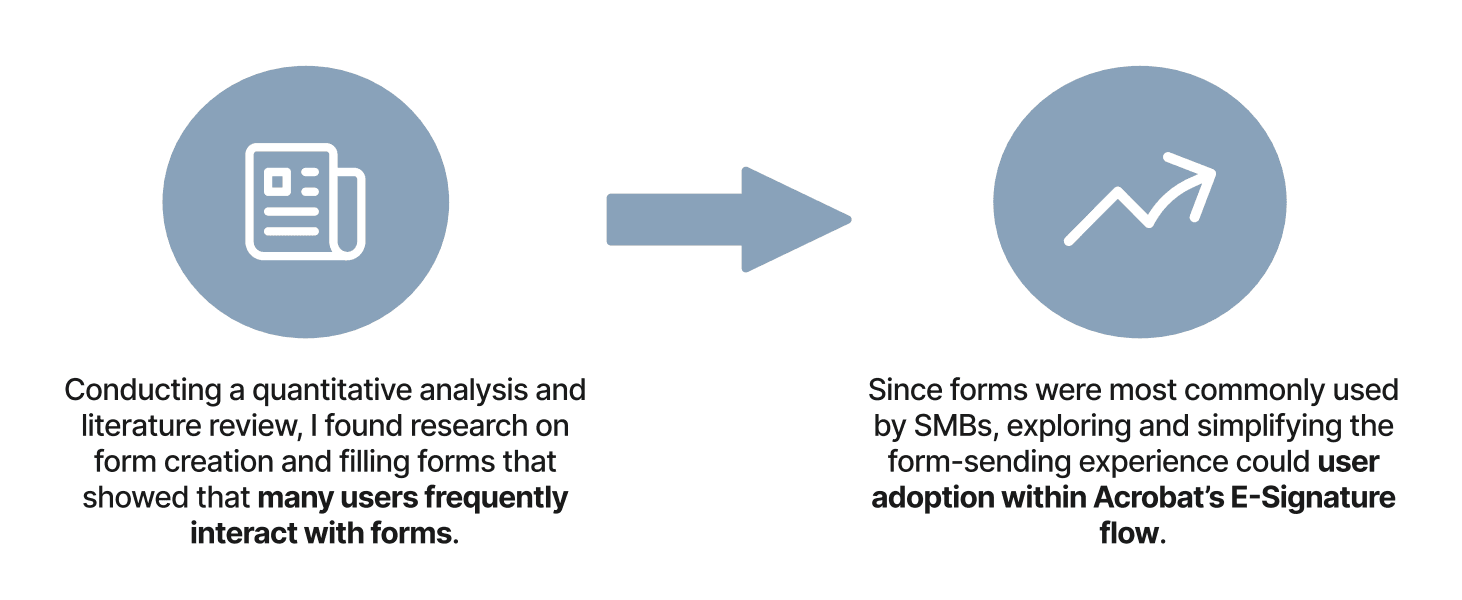
Why did I initiate this project?
Previously, there wasn't any existing research on the sending Forms experience.


Research Questions:
Research Questions:
Research Questions:
Based on my objective, I came up with 6 research questions to explore current user experiences and opportunities for Adobe to simplify those experiences.
Research Process & Methods
Material Prep. — 2.5 weeks
To lay the foundation of my research and prepare for data collection, I created the following:
Logged my project into Airtable
Created a research brief
Developed a discussion guide based on my 6 research questions
Created a screener guide and implemented it into Qualtrics
Software used:

Data Collection — 4 weeks
Speaking first-hand to users to understand their pain points was crucial, so I selected and interviewed 12 participants.
Recruited participants in UserInterviews — selected 12 participants out of 50+
Conducted data collection: 12 one-on-one interviews (each 60 min. on Microsoft Teams)
Used Slack to communicate with my stakeholders attending the interviews
Software used:

Data Analysis — 2 weeks
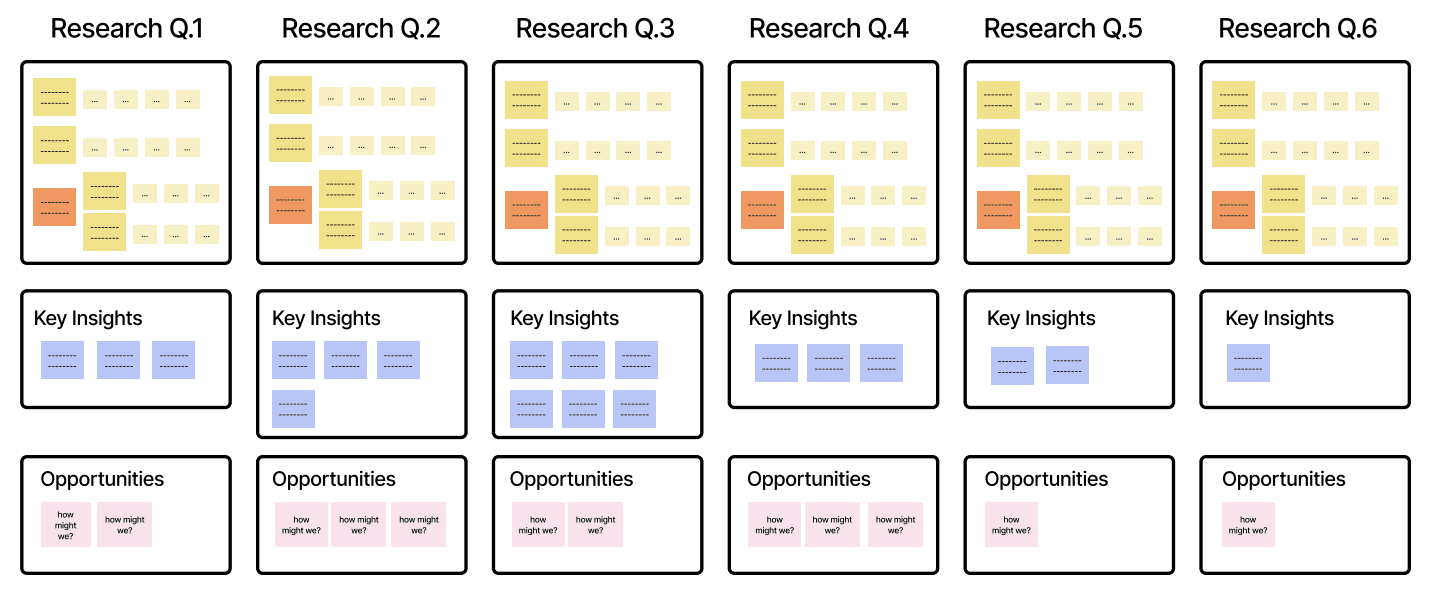
Organizing my data points into 6 themes (research questions) and connected overlapping insights, I synthesized my research into 20+ key insights.
Thematic Analysis:
Analyzed my interview notes to create 150+ data points
Organized all data into 6 overall categories (6 research questions)
Created sub-categories to gain deeper insights
Connected related sub-categories
Synthesis:
Considered my analysis to create key insights for each research question
Developed "how might we" questions for Designers to ideate upon
Software used:
What my thematic analysis +synthesis looked like...
Synthesis + Mapping — 2 weeks
With my key insights, I mapped out the user journey in-depth to visualize the form-sending process.
Journey-Mapping:
Created an in-depth journey map to visualize the current form-sending process
Divided the journey into 4 stages to make the flow easier to follow
Review + Feedback
Constantly communicating with my mentor for feedback and guidance
Reached out to senior researchers for general advice and review
Software used:
At a high level…
Creating a step-by-step journey, I was able to pinpoint where in the journey the key pain points lied, which came to be helpful for designers.
Decking + Presentation — 1.5 weeks
Building out a deck, I pinpointed the areas of my research that would drive the most business impact.
Built out three decks
Full, In-depth version (60 slides): presented to my stakeholders and immediate Document Cloud team — 10 people
Summary version (25 slides): presented to the broader Document Cloud and Acrobat teams — 20 people
Brief version (8 slides): presented to the entire intern class — 250+ people
Software used:

Material Prep. — 2.5 weeks
To lay the foundation of my research and prepare for data collection, I created the following:
Logged my project into Airtable
Created a research brief
Developed a discussion guide based on my 6 research questions
Created a screener guide and implemented it into Qualtrics
Software used:
Data Collection — 4 weeks
Speaking first-hand to users to understand their pain points was crucial, so I selected and interviewed 12 participants.
Recruited participants in UserInterviews — selected 12 participants out of 50+
Conducted data collection: 12 one-on-one interviews (each 60 min. on Microsoft Teams)
Used Slack to communicate with my stakeholders attending the interviews
Software used:
Data Analysis — 2 weeks
Organizing my data points into 6 themes (research questions) and connected overlapping insights, I synthesized my research into 20+ key insights.
Thematic Analysis:
Analyzed my interview notes to create 150+ data points
Organized all data into 6 overall categories (6 research questions)
Created sub-categories to gain deeper insights
Connected related sub-categories
Synthesis:
Considered my analysis to create key insights for each research question
Developed "how might we" questions for Designers to ideate upon
Software used:
What my thematic analysis +synthesis looked like...

Synthesis + Mapping — 2 weeks
With my key insights, I mapped out the user journey in-depth to visualize the form-sending process.
Journey-Mapping:
Created an in-depth journey map to visualize the current form-sending process
Divided the journey into 4 stages to make the flow easier to follow
Review + Feedback
Constantly communicating with my mentor for feedback and guidance
Reached out to senior researchers for general advice and review
Software used:
At a high level…
Creating a step-by-step journey, I was able to pinpoint where in the journey the key pain points lied, which came to be helpful for designers.
Decking + Presentation — 1.5 weeks
Building out a deck, I pinpointed the areas of my research that would drive the most business impact.
Built out three decks
Full, In-depth version (60 slides): presented to my stakeholders and immediate Document Cloud team — 10 people
Summary version (25 slides): presented to the broader Document Cloud and Acrobat teams — 20 people
Brief version (8 slides): presented to the entire intern class — 250+ people
Software used:
Material Prep. — 2.5 weeks
To lay the foundation of my research and prepare for data collection, I created the following:
Logged my project into Airtable
Created a research brief
Developed a discussion guide based on my 6 research questions
Created a screener guide and implemented it into Qualtrics
Software used:
Data Collection — 4 weeks
Speaking first-hand to users to understand their pain points was crucial, so I selected and interviewed 12 participants.
Recruited participants in UserInterviews — selected 12 participants out of 50+
Conducted data collection: 12 one-on-one interviews (each 60 min. on Microsoft Teams)
Used Slack to communicate with my stakeholders attending the interviews
Software used:
Data Analysis — 2 weeks
Organizing my data points into 6 themes (research questions) and connected overlapping insights, I synthesized my research into 20+ key insights.
Thematic Analysis:
Analyzed my interview notes to create 150+ data points
Organized all data into 6 overall categories (6 research questions)
Created sub-categories to gain deeper insights
Connected related sub-categories
Synthesis:
Considered my analysis to create key insights for each research question
Developed "how might we" questions for Designers to ideate upon
Software used:
What my thematic analysis +synthesis looked like...

Synthesis + Mapping — 2 weeks
With my key insights, I mapped out the user journey in-depth to visualize the form-sending process.
Journey-Mapping:
Created an in-depth journey map to visualize the current form-sending process
Divided the journey into 4 stages to make the flow easier to follow
Review + Feedback
Constantly communicating with my mentor for feedback and guidance
Reached out to senior researchers for general advice and review
Software used:
At a high level…
Creating a step-by-step journey, I was able to pinpoint where in the journey the key pain points lied, which came to be helpful for designers.
Decking + Presentation — 1.5 weeks
Building out a deck, I pinpointed the areas of my research that would drive the most business impact.
Built out three decks
Full, In-depth version (60 slides): presented to my stakeholders and immediate Document Cloud team — 10 people
Summary version (25 slides): presented to the broader Document Cloud and Acrobat teams — 20 people
Brief version (8 slides): presented to the entire intern class — 250+ people
Software used:
Key Insights + Pain Points
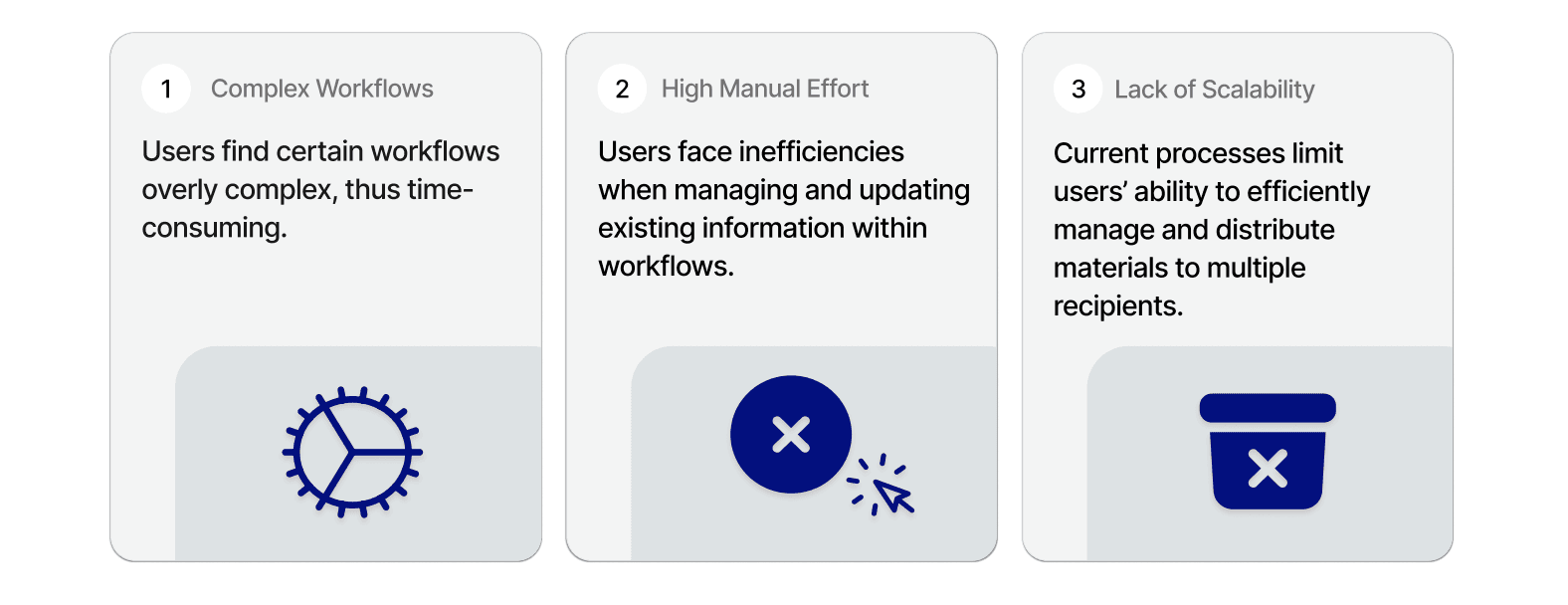
Small Business Users have many responsibilities, and they find sending forms to be time-consuming and burdensome.
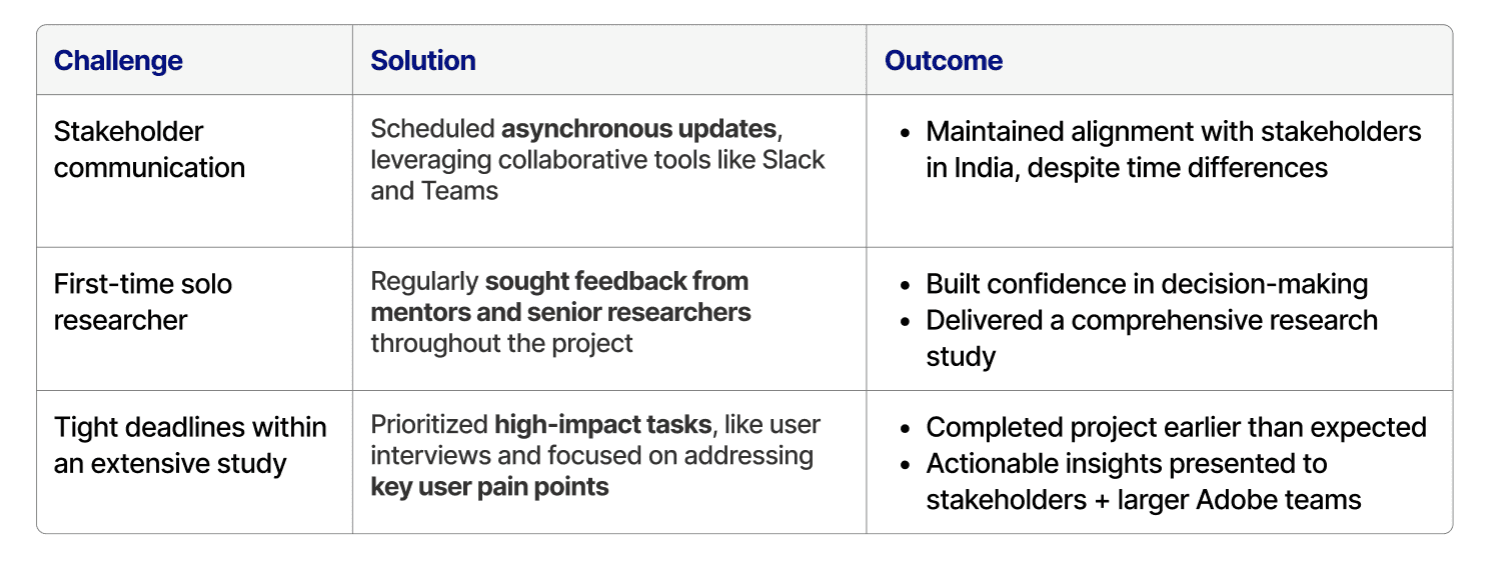
Facing challenges as a first-time solo researcher, I identified and implemented solutions to drive impactful outcomes.
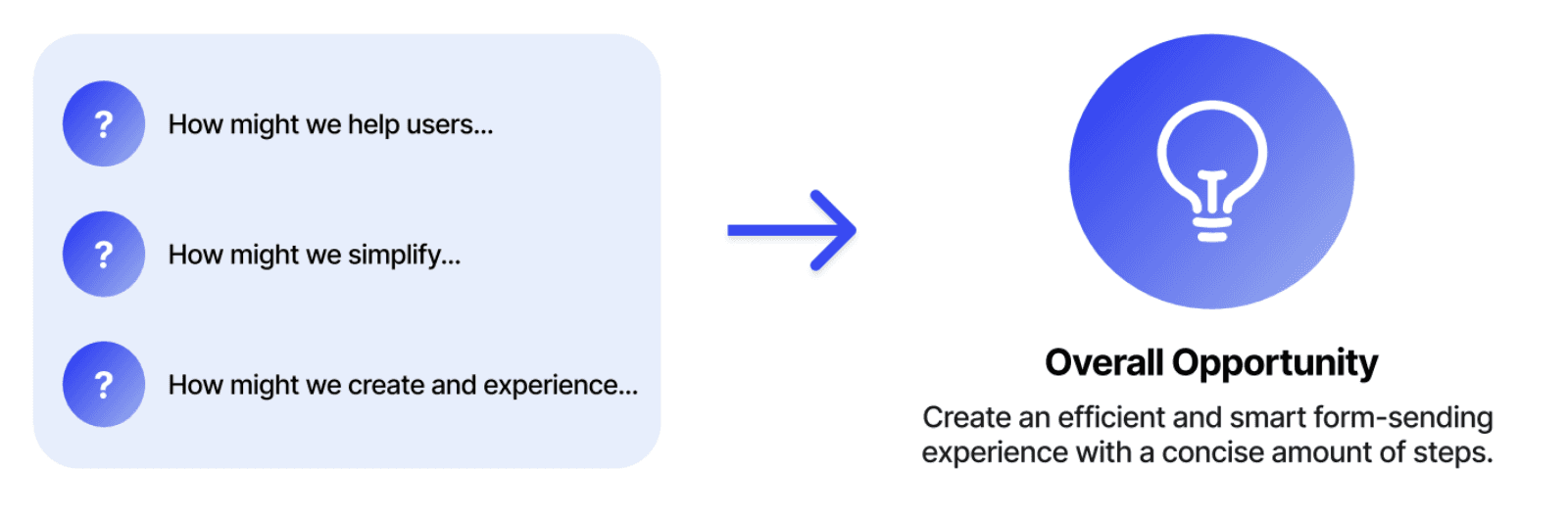
To address users' inefficiencies, I crafted 'How Might We' questions for each pain point, enabling designers and PMs to ideate effective solutions.
Business Impact
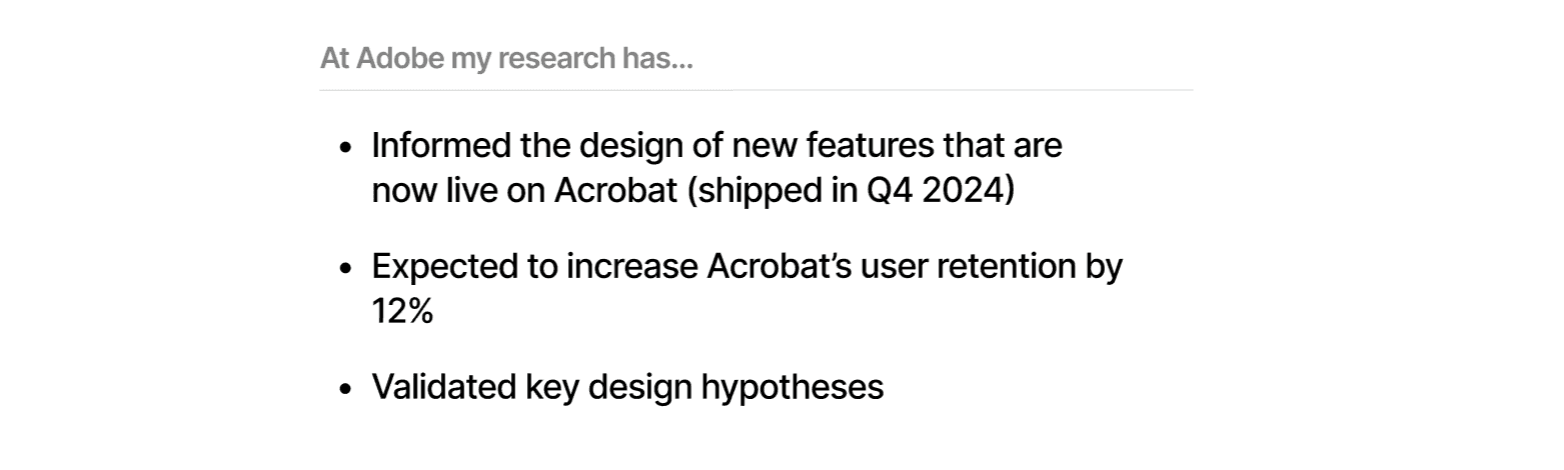
My project helped inform a design that has shipped and is now live to improve B2B user satisfaction and streamline e-sign processes.
Reflections
Growth in Professional Skills:
1.Stakeholder Alignment + Clear Communication
Providing regular research updates, involving stakeholders in user interviews, and leading a midpoint review, I grew confident when presenting questions and communicating insights clearly to stakeholders.
2.Cross-Functional Collaboration
Collaborating with PMs, designers, and engineers, I gained confidence incorporating new perspectives and feedback, ensuring the project delivered improvements aligned with user needs and stakeholder goals.
Self-Reflections:
Small Business Users have many responsibilities, and they find sending forms to be time-consuming and burdensome.

Facing challenges as a first-time solo researcher, I identified and implemented solutions to drive impactful outcomes.

To address users' inefficiencies, I crafted 'How Might We' questions for each pain point, enabling designers and PMs to ideate effective solutions.

Business Impact
My project helped inform a design that has shipped and is now live to improve B2B user satisfaction and streamline e-sign processes.

Reflections
Growth in Professional Skills:
1.Stakeholder Alignment + Clear Communication
Providing regular research updates, involving stakeholders in user interviews, and leading a midpoint review, I grew confident when presenting questions and communicating insights clearly to stakeholders.
2.Cross-Functional Collaboration
Collaborating with PMs, designers, and engineers, I gained confidence incorporating new perspectives and feedback, ensuring the project delivered improvements aligned with user needs and stakeholder goals.
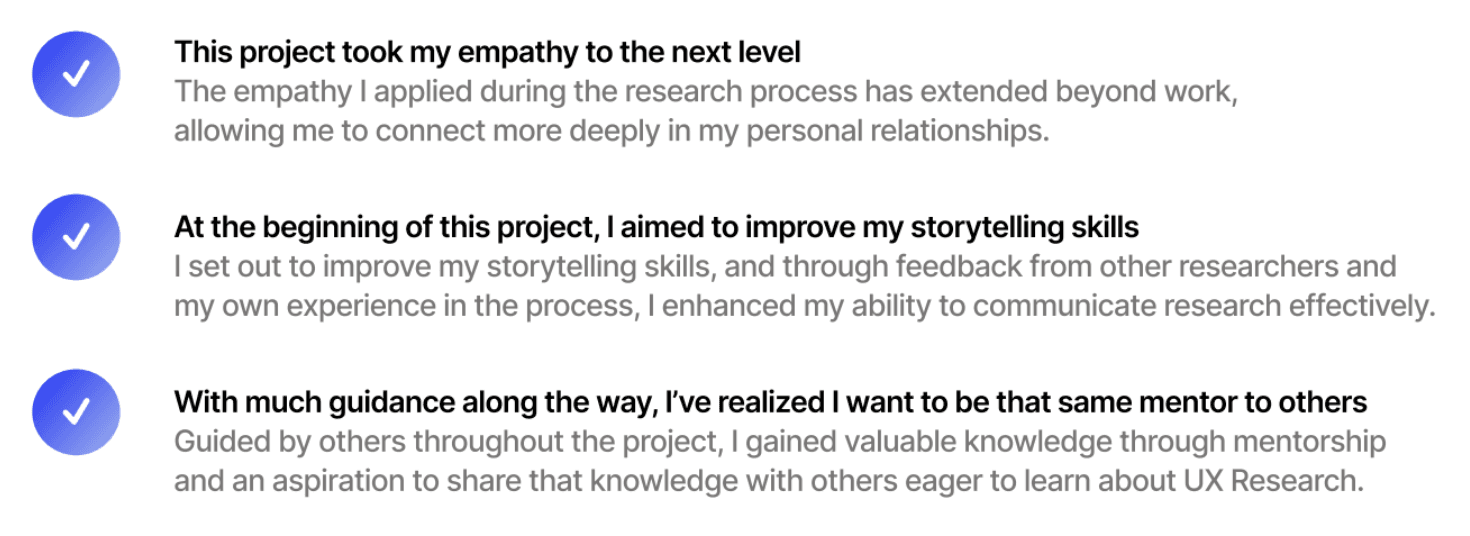
Self-Reflections:

Small Business Users have many responsibilities, and they find sending forms to be time-consuming and burdensome.

Facing challenges as a first-time solo researcher, I identified and implemented solutions to drive impactful outcomes.

To address users' inefficiencies, I crafted 'How Might We' questions for each pain point, enabling designers and PMs to ideate effective solutions.

Business Impact
My project helped inform a design that has shipped and is now live to improve B2B user satisfaction and streamline e-sign processes.

Reflections
Growth in Professional Skills:
1.Stakeholder Alignment + Clear Communication
Providing regular research updates, involving stakeholders in user interviews, and leading a midpoint review, I grew confident when presenting questions and communicating insights clearly to stakeholders.
2.Cross-Functional Collaboration
Collaborating with PMs, designers, and engineers, I gained confidence incorporating new perspectives and feedback, ensuring the project delivered improvements aligned with user needs and stakeholder goals.
Self-Reflections:

Check out some of my recent projects!


Simplifying the Form-Sending Process in Acrobat's E-Signature Space
Led mixed-method research (12 interviews, 100+ surveys) uncovering enterprise SaaS workflow pain points, driving insight-based design recommendations that boosted B2B value realization by 12% and culminated in shipping a new cross-platform e-signature experience (Q4 2024).
Role
UX Researcher
Role
UX Researcher
Role
UX Researcher
Duration
May 2024 - Aug. 2024
Duration
May 2024 - Aug. 2024
Duration
May 2024 - Aug. 2024
Team
PM & Designer (Stakeholders)
Team
PM & Designer (Stakeholders)
Team
PM & Designer (Stakeholders)
Tools
UserInterviews, Miro, Slack, AirTable, Qualtrics,Teams
Tools
UserInterviews, Miro, Slack, AirTable, Qualtrics,Teams
Tools
UserInterviews, Miro, Slack, AirTable, Qualtrics,Teams
For my full experience…
Due to the sensitive nature of this project, detailed insights about participants and certain project specifics cannot be disclosed. However, if you’re interested in learning more about what I worked on in more detail, please feel free to reach out!
For my full experience…
Due to the sensitive nature of this project, detailed insights about participants and certain project specifics cannot be disclosed. However, if you’re interested in learning more about what I worked on in more detail, please feel free to reach out!
For my full experience…
Due to the sensitive nature of this project, detailed insights about participants and certain project specifics cannot be disclosed. However, if you’re interested in learning more about what I worked on in more detail, please feel free to reach out!
My research was used to ship a new feature!
Document Cloud's First Experience Research Intern!
For 12 weeks, I had the greatest privilege to work as the first experience research intern on the Adobe Document Cloud team with an amazing and talented community of people.


Research Overview
Research Overview
Research Overview
This was a qualitative and foundational research study.
Some quantitative data from past research (surveys) were used to further support the business importance of my research study.
Research Method:
60-minute one-on-one interviews
Participants:
12 participants consisting of current Adobe customers and prospective/competitor customers
Small Business Users within different career industries
Interact with forms frequently
This was a qualitative and foundational research study.
Some quantitative data from past research (surveys) were used to further support the business importance of my research study.
Research Method:
60-minute one-on-one interviews
Participants:
12 participants consisting of current Adobe customers and prospective/competitor customers
Small Business Users within different career industries
Interact with forms frequently
This was a qualitative and foundational research study.
Some quantitative data from past research (surveys) were used to further support the business importance of my research study.
Research Method:
60-minute one-on-one interviews
Participants:
12 participants consisting of current Adobe customers and prospective/competitor customers
Small Business Users within different career industries
Interact with forms frequently
Why did I initiate this project?
Previously, there wasn't any existing research on the sending Forms experience.


Research Questions:
Research Questions:
Research Questions:
Based on my objective, I came up with 6 research questions to explore current user experiences and opportunities for Adobe to simplify those experiences.
Research Process & Methods
Material Prep. — 2.5 weeks
To lay the foundation of my research and prepare for data collection, I created the following:
Logged my project into Airtable
Created a research brief
Developed a discussion guide based on my 6 research questions
Created a screener guide and implemented it into Qualtrics
Software used:
Data Collection — 4 weeks
Speaking first-hand to users to understand their pain points was crucial, so I selected and interviewed 12 participants.
Recruited participants in UserInterviews — selected 12 participants out of 50+
Conducted data collection: 12 one-on-one interviews (each 60 min. on Microsoft Teams)
Used Slack to communicate with my stakeholders attending the interviews
Software used:
Data Analysis — 2 weeks
Organizing my data points into 6 themes (research questions) and connected overlapping insights, I synthesized my research into 20+ key insights.
Thematic Analysis:
Analyzed my interview notes to create 150+ data points
Organized all data into 6 overall categories (6 research questions)
Created sub-categories to gain deeper insights
Connected related sub-categories
Synthesis:
Considered my analysis to create key insights for each research question
Developed "how might we" questions for Designers to ideate upon
Software used:
What my thematic analysis +synthesis looked like...

Synthesis + Mapping — 2 weeks
With my key insights, I mapped out the user journey in-depth to visualize the form-sending process.
Journey-Mapping:
Created an in-depth journey map to visualize the current form-sending process
Divided the journey into 4 stages to make the flow easier to follow
Review + Feedback
Constantly communicating with my mentor for feedback and guidance
Reached out to senior researchers for general advice and review
Software used:
At a high level…
Creating a step-by-step journey, I was able to pinpoint where in the journey the key pain points lied, which came to be helpful for designers.
Decking + Presentation — 1.5 weeks
Building out a deck, I pinpointed the areas of my research that would drive the most business impact.
Built out three decks
Full, In-depth version (60 slides): presented to my stakeholders and immediate Document Cloud team — 10 people
Summary version (25 slides): presented to the broader Document Cloud and Acrobat teams — 20 people
Brief version (8 slides): presented to the entire intern class — 250+ people
Software used:
Material Prep. — 2.5 weeks
To lay the foundation of my research and prepare for data collection, I created the following:
Logged my project into Airtable
Created a research brief
Developed a discussion guide based on my 6 research questions
Created a screener guide and implemented it into Qualtrics
Software used:
Data Collection — 4 weeks
Speaking first-hand to users to understand their pain points was crucial, so I selected and interviewed 12 participants.
Recruited participants in UserInterviews — selected 12 participants out of 50+
Conducted data collection: 12 one-on-one interviews (each 60 min. on Microsoft Teams)
Used Slack to communicate with my stakeholders attending the interviews
Software used:
Data Analysis — 2 weeks
Organizing my data points into 6 themes (research questions) and connected overlapping insights, I synthesized my research into 20+ key insights.
Thematic Analysis:
Analyzed my interview notes to create 150+ data points
Organized all data into 6 overall categories (6 research questions)
Created sub-categories to gain deeper insights
Connected related sub-categories
Synthesis:
Considered my analysis to create key insights for each research question
Developed "how might we" questions for Designers to ideate upon
Software used:
What my thematic analysis +synthesis looked like...

Synthesis + Mapping — 2 weeks
With my key insights, I mapped out the user journey in-depth to visualize the form-sending process.
Journey-Mapping:
Created an in-depth journey map to visualize the current form-sending process
Divided the journey into 4 stages to make the flow easier to follow
Review + Feedback
Constantly communicating with my mentor for feedback and guidance
Reached out to senior researchers for general advice and review
Software used:
At a high level…
Creating a step-by-step journey, I was able to pinpoint where in the journey the key pain points lied, which came to be helpful for designers.
Decking + Presentation — 1.5 weeks
Building out a deck, I pinpointed the areas of my research that would drive the most business impact.
Built out three decks
Full, In-depth version (60 slides): presented to my stakeholders and immediate Document Cloud team — 10 people
Summary version (25 slides): presented to the broader Document Cloud and Acrobat teams — 20 people
Brief version (8 slides): presented to the entire intern class — 250+ people
Software used:
Material Prep. — 2.5 weeks
To lay the foundation of my research and prepare for data collection, I created the following:
Logged my project into Airtable
Created a research brief
Developed a discussion guide based on my 6 research questions
Created a screener guide and implemented it into Qualtrics
Software used:
Data Collection — 4 weeks
Speaking first-hand to users to understand their pain points was crucial, so I selected and interviewed 12 participants.
Recruited participants in UserInterviews — selected 12 participants out of 50+
Conducted data collection: 12 one-on-one interviews (each 60 min. on Microsoft Teams)
Used Slack to communicate with my stakeholders attending the interviews
Software used:
Data Analysis — 2 weeks
Organizing my data points into 6 themes (research questions) and connected overlapping insights, I synthesized my research into 20+ key insights.
Thematic Analysis:
Analyzed my interview notes to create 150+ data points
Organized all data into 6 overall categories (6 research questions)
Created sub-categories to gain deeper insights
Connected related sub-categories
Synthesis:
Considered my analysis to create key insights for each research question
Developed "how might we" questions for Designers to ideate upon
Software used:
What my thematic analysis +synthesis looked like...

Synthesis + Mapping — 2 weeks
With my key insights, I mapped out the user journey in-depth to visualize the form-sending process.
Journey-Mapping:
Created an in-depth journey map to visualize the current form-sending process
Divided the journey into 4 stages to make the flow easier to follow
Review + Feedback
Constantly communicating with my mentor for feedback and guidance
Reached out to senior researchers for general advice and review
Software used:
At a high level…
Creating a step-by-step journey, I was able to pinpoint where in the journey the key pain points lied, which came to be helpful for designers.
Decking + Presentation — 1.5 weeks
Building out a deck, I pinpointed the areas of my research that would drive the most business impact.
Built out three decks
Full, In-depth version (60 slides): presented to my stakeholders and immediate Document Cloud team — 10 people
Summary version (25 slides): presented to the broader Document Cloud and Acrobat teams — 20 people
Brief version (8 slides): presented to the entire intern class — 250+ people
Software used:
Key Insights + Pain Points
Small Business Users have many responsibilities, and they find sending forms to be time-consuming and burdensome.

Facing challenges as a first-time solo researcher, I identified and implemented solutions to drive impactful outcomes.

To address users' inefficiencies, I crafted 'How Might We' questions for each pain point, enabling designers and PMs to ideate effective solutions.

Business Impact
My project helped inform a design that has shipped and is now live to improve B2B user satisfaction and streamline e-sign processes.

Reflections
Growth in Professional Skills:
1.Stakeholder Alignment + Clear Communication
Providing regular research updates, involving stakeholders in user interviews, and leading a midpoint review, I grew confident when presenting questions and communicating insights clearly to stakeholders.
2.Cross-Functional Collaboration
Collaborating with PMs, designers, and engineers, I gained confidence incorporating new perspectives and feedback, ensuring the project delivered improvements aligned with user needs and stakeholder goals.
Self-Reflections:

Small Business Users have many responsibilities, and they find sending forms to be time-consuming and burdensome.

Facing challenges as a first-time solo researcher, I identified and implemented solutions to drive impactful outcomes.

To address users' inefficiencies, I crafted 'How Might We' questions for each pain point, enabling designers and PMs to ideate effective solutions.

Business Impact
My project helped inform a design that has shipped and is now live to improve B2B user satisfaction and streamline e-sign processes.

Reflections
Growth in Professional Skills:
1.Stakeholder Alignment + Clear Communication
Providing regular research updates, involving stakeholders in user interviews, and leading a midpoint review, I grew confident when presenting questions and communicating insights clearly to stakeholders.
2.Cross-Functional Collaboration
Collaborating with PMs, designers, and engineers, I gained confidence incorporating new perspectives and feedback, ensuring the project delivered improvements aligned with user needs and stakeholder goals.
Self-Reflections:

Small Business Users have many responsibilities, and they find sending forms to be time-consuming and burdensome.

Facing challenges as a first-time solo researcher, I identified and implemented solutions to drive impactful outcomes.

To address users' inefficiencies, I crafted 'How Might We' questions for each pain point, enabling designers and PMs to ideate effective solutions.

Business Impact
My project helped inform a design that has shipped and is now live to improve B2B user satisfaction and streamline e-sign processes.

Reflections
Growth in Professional Skills:
1.Stakeholder Alignment + Clear Communication
Providing regular research updates, involving stakeholders in user interviews, and leading a midpoint review, I grew confident when presenting questions and communicating insights clearly to stakeholders.
2.Cross-Functional Collaboration
Collaborating with PMs, designers, and engineers, I gained confidence incorporating new perspectives and feedback, ensuring the project delivered improvements aligned with user needs and stakeholder goals.
Self-Reflections:

Check out some of my recent projects!


Simplifying the Form-Sending Process in Acrobat's E-Signature Space
Led mixed-method research (12 interviews, 100+ surveys) uncovering enterprise SaaS workflow pain points, driving insight-based design recommendations that boosted B2B value realization by 12% and culminated in shipping a new cross-platform e-signature experience (Q4 2024).
Role
UX Researcher
Role
UX Researcher
Role
UX Researcher
Duration
May 2024 - Aug. 2024
Duration
May 2024 - Aug. 2024
Duration
May 2024 - Aug. 2024
Team
PM & Designer (Stakeholders)
Team
PM & Designer (Stakeholders)
Team
PM & Designer (Stakeholders)
Tools
UserInterviews, Miro, Slack, AirTable, Qualtrics,Teams
Tools
UserInterviews, Miro, Slack, AirTable, Qualtrics,Teams
Tools
UserInterviews, Miro, Slack, AirTable, Qualtrics,Teams
For my full experience…
Due to the sensitive nature of this project, detailed insights about participants and certain project specifics cannot be disclosed. However, if you’re interested in learning more about what I worked on in more detail, please feel free to reach out!
For my full experience…
Due to the sensitive nature of this project, detailed insights about participants and certain project specifics cannot be disclosed. However, if you’re interested in learning more about what I worked on in more detail, please feel free to reach out!
For my full experience…
Due to the sensitive nature of this project, detailed insights about participants and certain project specifics cannot be disclosed. However, if you’re interested in learning more about what I worked on in more detail, please feel free to reach out!
My research was used to ship a new feature!
Document Cloud's First Experience Research Intern!
For 12 weeks, I had the greatest privilege to work as the first experience research intern on the Adobe Document Cloud team with an amazing and talented community of people.


Research Overview
Research Overview
Research Overview
This was a qualitative and foundational research study.
Some quantitative data from past research (surveys) were used to further support the business importance of my research study.
Research Method:
60-minute one-on-one interviews
Participants:
12 participants consisting of current Adobe customers and prospective/competitor customers
Small Business Users within different career industries
Interact with forms frequently
This was a qualitative and foundational research study.
Some quantitative data from past research (surveys) were used to further support the business importance of my research study.
Research Method:
60-minute one-on-one interviews
Participants:
12 participants consisting of current Adobe customers and prospective/competitor customers
Small Business Users within different career industries
Interact with forms frequently
This was a qualitative and foundational research study.
Some quantitative data from past research (surveys) were used to further support the business importance of my research study.
Research Method:
60-minute one-on-one interviews
Participants:
12 participants consisting of current Adobe customers and prospective/competitor customers
Small Business Users within different career industries
Interact with forms frequently
Why did I initiate this project?
Previously, there wasn't any existing research on the sending Forms experience.


Research Questions:
Research Questions:
Research Questions:
Based on my objective, I came up with 6 research questions to explore current user experiences and opportunities for Adobe to simplify those experiences.
Research Process & Methods
Material Prep. — 2.5 weeks
To lay the foundation of my research and prepare for data collection, I created the following:
Logged my project into Airtable
Created a research brief
Developed a discussion guide based on my 6 research questions
Created a screener guide and implemented it into Qualtrics
Software used:
Data Collection — 4 weeks
Speaking first-hand to users to understand their pain points was crucial, so I selected and interviewed 12 participants.
Recruited participants in UserInterviews — selected 12 participants out of 50+
Conducted data collection: 12 one-on-one interviews (each 60 min. on Microsoft Teams)
Used Slack to communicate with my stakeholders attending the interviews
Software used:
Data Analysis — 2 weeks
Organizing my data points into 6 themes (research questions) and connected overlapping insights, I synthesized my research into 20+ key insights.
Thematic Analysis:
Analyzed my interview notes to create 150+ data points
Organized all data into 6 overall categories (6 research questions)
Created sub-categories to gain deeper insights
Connected related sub-categories
Synthesis:
Considered my analysis to create key insights for each research question
Developed "how might we" questions for Designers to ideate upon
Software used:
What my thematic analysis +synthesis looked like...

Synthesis + Mapping — 2 weeks
With my key insights, I mapped out the user journey in-depth to visualize the form-sending process.
Journey-Mapping:
Created an in-depth journey map to visualize the current form-sending process
Divided the journey into 4 stages to make the flow easier to follow
Review + Feedback
Constantly communicating with my mentor for feedback and guidance
Reached out to senior researchers for general advice and review
Software used:
At a high level…
Creating a step-by-step journey, I was able to pinpoint where in the journey the key pain points lied, which came to be helpful for designers.
Decking + Presentation — 1.5 weeks
Building out a deck, I pinpointed the areas of my research that would drive the most business impact.
Built out three decks
Full, In-depth version (60 slides): presented to my stakeholders and immediate Document Cloud team — 10 people
Summary version (25 slides): presented to the broader Document Cloud and Acrobat teams — 20 people
Brief version (8 slides): presented to the entire intern class — 250+ people
Software used:
Material Prep. — 2.5 weeks
To lay the foundation of my research and prepare for data collection, I created the following:
Logged my project into Airtable
Created a research brief
Developed a discussion guide based on my 6 research questions
Created a screener guide and implemented it into Qualtrics
Software used:
Data Collection — 4 weeks
Speaking first-hand to users to understand their pain points was crucial, so I selected and interviewed 12 participants.
Recruited participants in UserInterviews — selected 12 participants out of 50+
Conducted data collection: 12 one-on-one interviews (each 60 min. on Microsoft Teams)
Used Slack to communicate with my stakeholders attending the interviews
Software used:
Data Analysis — 2 weeks
Organizing my data points into 6 themes (research questions) and connected overlapping insights, I synthesized my research into 20+ key insights.
Thematic Analysis:
Analyzed my interview notes to create 150+ data points
Organized all data into 6 overall categories (6 research questions)
Created sub-categories to gain deeper insights
Connected related sub-categories
Synthesis:
Considered my analysis to create key insights for each research question
Developed "how might we" questions for Designers to ideate upon
Software used:
What my thematic analysis +synthesis looked like...

Synthesis + Mapping — 2 weeks
With my key insights, I mapped out the user journey in-depth to visualize the form-sending process.
Journey-Mapping:
Created an in-depth journey map to visualize the current form-sending process
Divided the journey into 4 stages to make the flow easier to follow
Review + Feedback
Constantly communicating with my mentor for feedback and guidance
Reached out to senior researchers for general advice and review
Software used:
At a high level…
Creating a step-by-step journey, I was able to pinpoint where in the journey the key pain points lied, which came to be helpful for designers.
Decking + Presentation — 1.5 weeks
Building out a deck, I pinpointed the areas of my research that would drive the most business impact.
Built out three decks
Full, In-depth version (60 slides): presented to my stakeholders and immediate Document Cloud team — 10 people
Summary version (25 slides): presented to the broader Document Cloud and Acrobat teams — 20 people
Brief version (8 slides): presented to the entire intern class — 250+ people
Software used:
Material Prep. — 2.5 weeks
To lay the foundation of my research and prepare for data collection, I created the following:
Logged my project into Airtable
Created a research brief
Developed a discussion guide based on my 6 research questions
Created a screener guide and implemented it into Qualtrics
Software used:
Data Collection — 4 weeks
Speaking first-hand to users to understand their pain points was crucial, so I selected and interviewed 12 participants.
Recruited participants in UserInterviews — selected 12 participants out of 50+
Conducted data collection: 12 one-on-one interviews (each 60 min. on Microsoft Teams)
Used Slack to communicate with my stakeholders attending the interviews
Software used:
Data Analysis — 2 weeks
Organizing my data points into 6 themes (research questions) and connected overlapping insights, I synthesized my research into 20+ key insights.
Thematic Analysis:
Analyzed my interview notes to create 150+ data points
Organized all data into 6 overall categories (6 research questions)
Created sub-categories to gain deeper insights
Connected related sub-categories
Synthesis:
Considered my analysis to create key insights for each research question
Developed "how might we" questions for Designers to ideate upon
Software used:
What my thematic analysis +synthesis looked like...

Synthesis + Mapping — 2 weeks
With my key insights, I mapped out the user journey in-depth to visualize the form-sending process.
Journey-Mapping:
Created an in-depth journey map to visualize the current form-sending process
Divided the journey into 4 stages to make the flow easier to follow
Review + Feedback
Constantly communicating with my mentor for feedback and guidance
Reached out to senior researchers for general advice and review
Software used:
At a high level…
Creating a step-by-step journey, I was able to pinpoint where in the journey the key pain points lied, which came to be helpful for designers.
Decking + Presentation — 1.5 weeks
Building out a deck, I pinpointed the areas of my research that would drive the most business impact.
Built out three decks
Full, In-depth version (60 slides): presented to my stakeholders and immediate Document Cloud team — 10 people
Summary version (25 slides): presented to the broader Document Cloud and Acrobat teams — 20 people
Brief version (8 slides): presented to the entire intern class — 250+ people
Software used:
Key Insights + Pain Points
Small Business Users have many responsibilities, and they find sending forms to be time-consuming and burdensome.

Facing challenges as a first-time solo researcher, I identified and implemented solutions to drive impactful outcomes.

To address users' inefficiencies, I crafted 'How Might We' questions for each pain point, enabling designers and PMs to ideate effective solutions.

Business Impact
My project helped inform a design that has shipped and is now live to improve B2B user satisfaction and streamline e-sign processes.

Reflections
Growth in Professional Skills:
1.Stakeholder Alignment + Clear Communication
Providing regular research updates, involving stakeholders in user interviews, and leading a midpoint review, I grew confident when presenting questions and communicating insights clearly to stakeholders.
2.Cross-Functional Collaboration
Collaborating with PMs, designers, and engineers, I gained confidence incorporating new perspectives and feedback, ensuring the project delivered improvements aligned with user needs and stakeholder goals.
Self-Reflections:

Small Business Users have many responsibilities, and they find sending forms to be time-consuming and burdensome.

Facing challenges as a first-time solo researcher, I identified and implemented solutions to drive impactful outcomes.

To address users' inefficiencies, I crafted 'How Might We' questions for each pain point, enabling designers and PMs to ideate effective solutions.

Business Impact
My project helped inform a design that has shipped and is now live to improve B2B user satisfaction and streamline e-sign processes.

Reflections
Growth in Professional Skills:
1.Stakeholder Alignment + Clear Communication
Providing regular research updates, involving stakeholders in user interviews, and leading a midpoint review, I grew confident when presenting questions and communicating insights clearly to stakeholders.
2.Cross-Functional Collaboration
Collaborating with PMs, designers, and engineers, I gained confidence incorporating new perspectives and feedback, ensuring the project delivered improvements aligned with user needs and stakeholder goals.
Self-Reflections:

Small Business Users have many responsibilities, and they find sending forms to be time-consuming and burdensome.

Facing challenges as a first-time solo researcher, I identified and implemented solutions to drive impactful outcomes.

To address users' inefficiencies, I crafted 'How Might We' questions for each pain point, enabling designers and PMs to ideate effective solutions.

Business Impact
My project helped inform a design that has shipped and is now live to improve B2B user satisfaction and streamline e-sign processes.

Reflections
Growth in Professional Skills:
1.Stakeholder Alignment + Clear Communication
Providing regular research updates, involving stakeholders in user interviews, and leading a midpoint review, I grew confident when presenting questions and communicating insights clearly to stakeholders.
2.Cross-Functional Collaboration
Collaborating with PMs, designers, and engineers, I gained confidence incorporating new perspectives and feedback, ensuring the project delivered improvements aligned with user needs and stakeholder goals.
Self-Reflections: